Aeration Best Practices in 2026: Is Double Aeration a Good Thing?
Short answer
No. Double core aeration is usually a marketing tactic, not a better method. Walk-behind aerators only put about 250 pounds of force on the tines, which is often not enough to pull real cores in Northern Virginia clay, so companies go over the lawn twice to compensate. A proper 2026 job is a single pass with a stand-on aerator that can apply 400 to 600 pounds of force, then a last perimeter pass so you are not driving over wet cores.
What is core aeration actually supposed to do?
The objective of aeration is to pull cores of soil, which relieves compaction so nutrients, water, and air can reach the roots — and it is the ideal time to overseed. If the machine is not coming up with a real plug, you did not aerate. You poked the lawn.
That distinction matters on Northern Virginia clay. Compacted ground here can stop a probe well before the tines of a light machine ever reach root depth.
Why does double aeration exist in the first place?
Double aeration exists because older walk-behind units cannot put enough force into this soil. Those machines weigh about 250 pounds total, so 250 pounds is roughly the most force they can put on the tines.
I have confirmed this many times with a soil compaction meter around Bristow and the rest of our area: 250 pounds of force is sometimes not enough to push a probe even half an inch into the ground. What is required, in most cases, is 400 pounds of force or more. A walk-behind unit simply cannot do that.
So companies that were not pulling satisfactory cores started going over the lawn a second time. If a company still markets 'we do double core aeration,' it usually points to that older equipment and that workaround, not to a better result.
Walk-behind versus a stand-on aerator
A proper aeration job in 2026 is a single pass with a stand-on unit that can apply the force Virginia clay actually needs. The extra pass is what you do when the first one did not work.
| Measure | Walk-behind unit | Stand-on Stinger |
|---|---|---|
| Force on the tines | About 250 lb — the weight of the machine | Up to about 600 lb, applied hydraulically |
| Typical result in our clay | Shallow or incomplete cores | Full cores on the first pass |
| The extra pass | Often sold as double aeration | Not needed, and it damages the lawn |
| Traffic after cores are pulled | High — you go back over the same ground | Low — working passes, then the perimeter last |
What a proper aeration job looks like in 2026
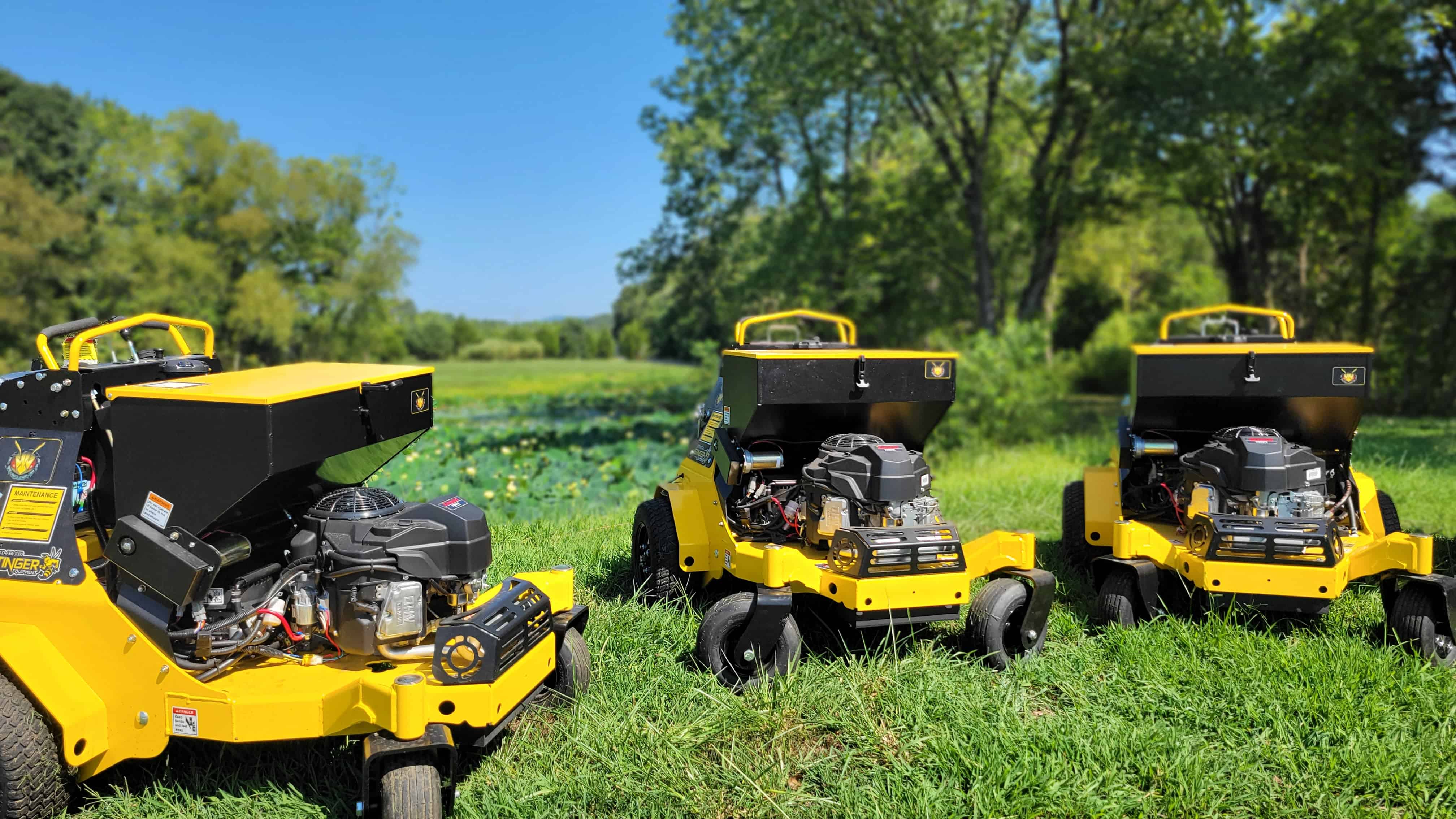
The top-of-the-line machine for this work is the Stinger stand-on aerator. With these units we can put out upwards of 600 pounds of force hydraulically to push the tines in and pull the core, which is why we can do it on the first pass.
That is the job we sell as core aeration and overseeding: one thorough pass, seed into the open holes, and get off the grass. Timing still matters — the fall window in Northern Virginia is late August through mid-October — but equipment is what decides whether you get cores or just tire tracks.
- 1Water a dry lawn the day before so the tines can pull full cores.
- 2Make your working passes across the lawn, pulling cores as you go.
- 3Save the perimeter pass for last so you are not driving over wet cores.
- 4Overseed the same day into the open holes.
- 5Leave the cores on the surface. Rain and mowing melt them back in.
Why a second pass can wreck the lawn
Any time you aerate, you are pulling out wet cores of soil. The last thing you want is to travel back across the lawn where those cores have been pulled — it smashes them into the grass, and in a lot of cases it kills the turf in those spots.
A proper job is simple: do your passes, leave the perimeter for last, and stop. Extra traffic after the cores are out is not thoroughness. It is a mess.
How to read a double-aeration sales pitch
If somebody says they offer double-pass aeration, be wary. It usually means older equipment, outdated methods, and marketing written to close the job rather than describe how the work is actually done.
Ask what machine they use and whether they can pull cores in this clay on the first pass. That question belongs on the same list as licensing and measurement when you choose a lawn care company in Northern Virginia.
Want this handled for you?
Simply Turf is a licensed, locally owned turf-health company in Gainesville, VA. Free quote, no contracts, and honest advice about what your lawn actually needs.
Common questions
Not on Northern Virginia clay, and not with equipment that can apply enough force the first time. A second pass is how companies compensate for walk-behind machines that cannot pull real cores. Once cores are on the surface, driving over them again smashes them into the turf.
In most cases, 400 pounds or more. I have checked this with a soil compaction meter: 250 pounds — about what a walk-behind unit can apply — is sometimes not enough to push a probe half an inch into the ground. Stand-on units can apply around 600 pounds hydraulically.
It is a ride-on (stand-on) core aerator that uses hydraulics to push the tines into the soil instead of relying on the weight of a walk-behind machine. That extra force is what lets us pull cores in heavy Virginia clay on the first pass.
On softer, recently worked soil, maybe. On compacted Northern Virginia clay, it often cannot pull a real core no matter how many times you go over the lawn, and each extra pass flattens the plugs you did get. If the tines are not coming up with soil, stop and rent something heavier, or hire it out.