When to Aerate and Overseed in Northern Virginia
Short answer
Aerate and overseed a Northern Virginia lawn between late August and mid-October, and earlier in that window beats later. Soil is still warm enough for fast germination while the air has cooled off, which is what tall fescue needs to root before winter. Spring seeding is the common mistake here — those seedlings rarely survive their first Virginia summer.
When is the best time to aerate and overseed?
Late August through mid-October, with the first two weeks of September as the sweet spot. Seed down that early gets eight to ten weeks of root growth before the soil cools, and every week past September takes some of that away.
Soil temperature drives the window, not the date: a cool, wet August opens it early, and a hot September pushes it back a week.
| Window | What is happening | What to do |
|---|---|---|
| Late August | Soil warm, nights starting to cool | Book the job. Water a dry lawn a day ahead so the aerator pulls full cores. |
| Early September | Best germination conditions of the year | Core aerate and overseed the same day, then feed with a starter fertilizer. |
| Mid to late September | Seed germinating, first blades up | Light, frequent watering. Keep traffic off the seedbed. |
| Early October | Seedlings tillering, roots pushing down | First mow once the new grass hits about 3 inches. Start tapering water. |
| Mid to late October | Last usable window | Seed only if you have to, and expect thinner results. Second fall feeding. |
| November | Soil below the germination range | Too late to seed. Final feeding, last mow, keep leaves cleared. |
Why fall and not spring?
Because spring-seeded tall fescue does not survive its first Northern Virginia summer. A seedling started in April gets about ten weeks of rooting before July heat arrives, and shallow roots in baked clay do not make it.
Fall reverses that. September gives you warm soil and cool air at once, so the plant spends its energy on roots instead of survival. Our Northern Virginia lawn care calendar shows how the rest of the year lines up around this one job.
Why core aeration and not spike aeration?
Because core aeration removes soil while spike aeration only pushes it around, shoving soil sideways and building a compacted wall around every hole. On heavy clay that is worse than doing nothing.
A core aerator pulls finger-sized plugs and drops them on the surface, which relieves compaction and lets air, water, and fertilizer reach the root zone. Leave the cores where they land; two or three weeks of rain and mowing melts them back in.
Clay compaction is the default condition here, worst where construction stripped the topsoil, as in much of the newer building around Ashburn.
Why aeration and overseeding belong on the same day
Because the open holes are what give seed real soil contact. Seed broadcast on an un-aerated lawn sits on thatch and dry crust, while seed dropped into a fresh core hole is surrounded by moist soil at the right depth.
Tall fescue is also a bunch grass, so it cannot fill its own gaps — a thin patch stays thin because the plants around it do not spread into it. That makes overseeding annual maintenance rather than a one-time repair, and a tall fescue lawn thins out every year it is skipped.
- 1Mow short, around 2.5 inches, and bag the clippings so seed can reach soil.
- 2Flag irrigation heads, invisible fence, and shallow utility lines.
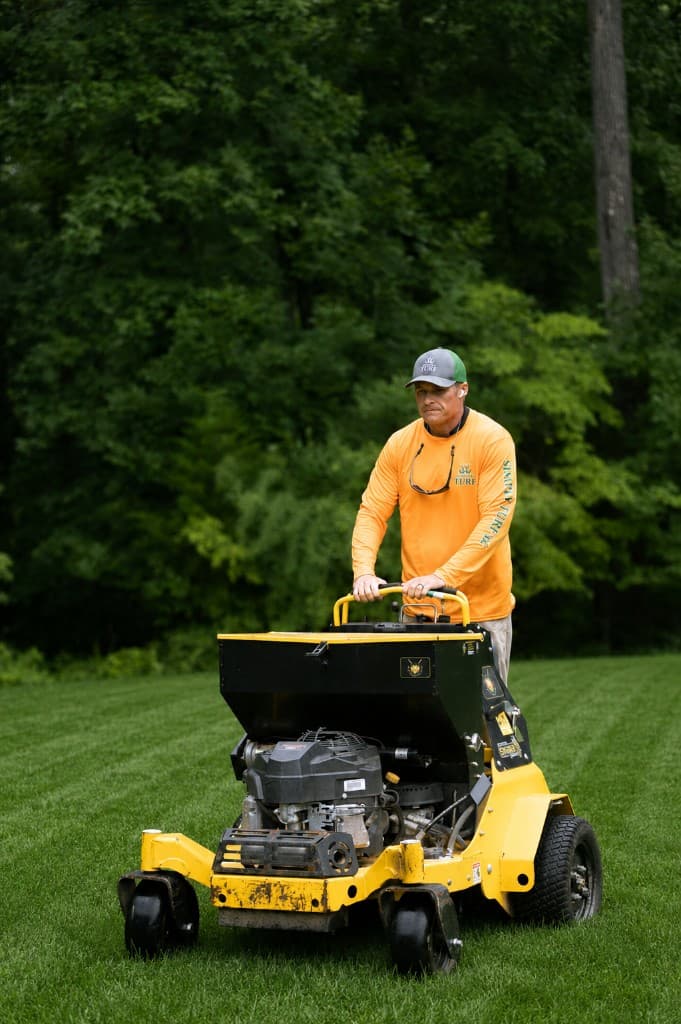
- 3Core aerate to 20 to 30 holes per square foot. A stand-on unit that can apply enough force does this in one pass — a second pass on wet cores is not a better job.
- 4Overseed the same day at a generous rate — heavier for a renovation than for annual maintenance — using a blue-tag certified blend of improved turf-type tall fescue.
- 5Feed with a starter fertilizer and leave the cores on the surface.
- 6Water light and often for two to three weeks. Our aeration and overseeding service covers everything but the watering.
How to water new seed
Light and frequent for two to three weeks, then taper to deep soakings. Seed sits in the top half inch of soil, so early on the only thing that matters is that the surface never dries out.
After the first mow, switch to about an inch a week in one or two soakings, early in the morning. Deep and infrequent pulls roots down into the clay; daily sprinkling keeps them where next summer will find them.
What not to do after seeding
Do not put down pre-emergent herbicide for the rest of the fall. The chemistry that stops crabgrass seed from germinating stops grass seed too, so one fall application wastes the entire seeding.
- No pre-emergent or weed-and-feed until the new grass has been mowed three or four times
- Hold the first mow until the new grass is about 3 inches tall, and use a sharp blade
- Keep leaves off the seedbed — a wet leaf mat smothers seedlings in a week
- Save the pre-emergent for crabgrass season next spring
When is compost topdressing worth adding?
When the problem is dead soil rather than compacted soil. Aeration relieves compaction but cannot put organic matter back into subsoil scraped bare during construction — that takes compost topdressing worked into fresh aeration holes. On an established lawn with decent soil, skip it and buy more seed.
Want this handled for you?
Simply Turf is a licensed, locally owned turf-health company in Gainesville, VA. Free quote, no contracts, and honest advice about what your lawn actually needs.
Common questions
Mid-October is the practical cutoff here. After that, soil drops below the temperature fescue needs to germinate, and seed that does sprout goes into winter without enough root. Wait for next fall rather than seeding in spring.
Most lawns here benefit every year, since fescue cannot fill its own gaps. Full sun and good soil can stretch that to every other year, while shade, dog traffic, and thin construction soil keep it annual.
On heavy clay, yes — compaction comes back within a season of traffic and rain. Lawns with better soil structure can go every other year. Since the two jobs pair naturally, doing both each fall is simplest.
Usually not, because real thatch is uncommon in tall fescue. What feels spongy in a fescue lawn here is normally compacted soil and surface roots, which core aeration fixes and dethatching does not.