
Frequently asked questions
Lawn Care Questions, Answered Straight
The 39 questions we hear most from Northern Virginia homeowners — about timing, safety, pricing, and what a lawn program can and cannot do.
Services & programs
We are a turf-health company, not a landscaping generalist. That means lawn fertilization, weed control, core aeration and overseeding, compost topdressing, and mosquito and tick control. We do not do mulch, plantings, hardscape, or design.
Mowing is not our main business — we are a fertilization and weed control company first. We do offer a weekly mowing service for customers who want it, but the vast majority of our work is turf health. If you only need mowing, another company is probably a better fit.
A season of scheduled visits combining slow-release fertilization with pre- and post-emergent weed control, timed to how cool-season grass grows in Northern Virginia. Aeration, overseeding, compost topdressing, and mosquito control are separate services you can add. Visits are spaced roughly every six to eight weeks from early spring through late fall, so the lawn stays covered through the whole growing season.
No. Services are sold individually and you can start with one application. Most customers end up on the full-season program because timing is what makes the results stick, but nothing obligates you to it.
Usually, but it takes a full season and a fall renovation, not a single visit. The order matters: get weeds under control, then core aerate and overseed in early fall, then feed through the fall to establish the new grass. Anyone promising to fix a bare lawn in one spring visit is selling you something.
Yes. Most Northern Virginia lawns are tall fescue or a fescue and Kentucky bluegrass mix, which is what our programs are built around. We also treat zoysia and bermuda lawns, though the timing and products differ — tell us what you have when you request a quote.
Yes, as add-on treatments. Brown patch is the common summer disease on tall fescue here, and grub damage typically shows up in late July and August. Both are treated more cheaply as prevention than as a rescue — see why lawns get brown spots in summer for how to tell the difference.
Timing & seasons
Any time, but the two highest-value entry points are mid-March, before crabgrass germinates, and late August, ahead of fall aeration and overseeding. If you are reading this outside those windows, starting now still beats waiting — the month-by-month calendar shows what your lawn needs right now.
Late August through mid-October, and earlier in that range is better. Soil is still warm enough for fast germination while air temperatures have cooled, so seedlings root before winter. Spring seeding usually fails here because young fescue cannot survive its first Virginia summer.
Ask what machine they use first. On Northern Virginia clay, a second pass is usually how companies compensate for walk-behind units that cannot pull real cores. A stand-on aerator that can apply enough force does the job in one pass, and driving back over wet cores smashes them into the turf. Why double aeration is usually a marketing line.
Before soil temperature at two inches reaches roughly 55°F, which is typically mid-March to early April in Northern Virginia. Warm springs move the window earlier, so we watch soil temperature rather than the calendar. Once crabgrass has germinated, pre-emergent no longer helps.
Color usually improves within one to two weeks of the first feeding. Weed knockdown on broadleaf weeds takes one to three weeks depending on the weed and the weather. Real density — the thick lawn people actually want — takes a full season, and a fall aeration and overseeding is what accelerates it.
We run limited service in the deep winter months because dormant turf does not take up nutrients. Late fall feedings run into November, and the season restarts with pre-emergent in March. Winter is a good time to book, since early-season routes fill up.
Applications are spaced roughly every six to eight weeks through the growing season, adjusted for weather and what your lawn needs. Slow-release nitrogen feeds for 10 to 12 weeks, so visits are about maintaining coverage, not repeating the same product.
Safety, kids & pets
Yes, once the application has dried. Every product we use is EPA-approved and applied at label rates by technicians licensed by the Commonwealth of Virginia. Keep children and pets off the lawn until it is dry — typically about two hours, longer in humid or cool weather.
It means the risk comes from contact with wet product, not from the treated lawn itself. Once granules have settled or a liquid has dried onto the leaf, there is nothing to transfer onto paws, bare feet, or hands. The full explanation is here, including what we do differently around play areas.
Our fertilizers are organic-based and slow-release, which means the organic fraction feeds soil biology while the nutrients release over 10 to 12 weeks. We are not a fully organic program — weed control uses conventional herbicides applied at label rates, because organic alternatives do not reliably control crabgrass or stiltgrass in this climate. We would rather tell you that plainly than market a word.
Yes, when label setbacks are followed, and we follow them. Product labels specify buffer distances near wells and surface water, and applications are made by a VDACS certified applicator who is legally responsible for observing them. We also blow granules off driveways and sidewalks so nothing washes into a storm drain.
We apply mosquito barrier treatments to shaded resting habitat — shrub lines, leaf litter, and the undersides of foliage — rather than to flowering plants, and we avoid blooming areas. Timing applications outside peak pollinator activity reduces exposure further. If you keep bees, tell us before your first visit so we can plan around the hive.
For granular fertilizer, watering afterward helps move it into the soil, but it is not required. For weed control, do the opposite: leave the lawn dry for at least 24 hours so the product has time to be absorbed by the weed. We will tell you which applies after each visit.
Scheduling & what to expect
We email you the Friday before your scheduled service week, then again the morning of your service. We ask that gates are unlocked and toys, hoses, and furniture are cleared off the lawn so the technician can treat the whole area.
No. We complete the work as scheduled and leave a door hanger and a yard sign, and you get a post-service email with any specific notes about your lawn. Most customers never need to be there.
We reschedule. Applying weed control immediately before a downpour wastes the product and your money, so routes shift around the weather. You will get a new notification when the visit is rescheduled.
Call or text us and we will come back out. Weed pressure does not run on our schedule, and a return visit between scheduled applications is part of the program rather than an upsell.
We typically respond to a quote request in 30 minutes or less during business hours, and most new lawns are on the schedule within the next service week. Peak spring and early-fall weeks book out further, so earlier is better.
Yes, we treat commercial turf and common areas alongside residential lawns. Larger properties are quoted the same way — measured square footage and what the turf actually needs. Call (703) 268-9900 to talk through a property.
Pricing, billing & contracts
Pricing is based on the measured square footage of your turf, so a townhome lot and a two-acre parcel are quoted very differently. There are no packages you have to guess your way into. Our cost guide explains what drives the number and how to compare quotes honestly.
No. All of our services are contract-free — you pay as you go and can stop at any time, for any reason, without a cancellation fee. We would rather keep customers because the lawn looks good than because they are locked in.
You are billed per service and can manage everything online through the customer portal, including payment methods, invoices, and your service history. No prepayment is required.
We run seasonal promotions and occasional prepay offers rather than a permanent discount schedule. Ask when you request your quote and we will tell you what is currently available.
Free, and yes. We measure the property, look at what is growing, and quote the services your lawn actually needs — including telling you when a service you asked about will not help. Call or text (703) 268-9900, or request a quote online.
Because lawn care price is mostly a function of how much product goes down and how many visits you get. A quote well below the others usually means fewer applications, lower rates, or an unlicensed applicator. Here is what to compare so you are looking at the same thing on both quotes.
The company & the guarantee
Yes. Simply Turf holds a Virginia pesticide business license, and owner Patrick Klippen is a VDACS certified applicator (#141054) with a B.S. in Landscape Horticulture from Colorado State University. Every application is made under that license, which is worth verifying with any company you consider.
No. Simply Turf is locally owned and operated out of Gainesville, VA, founded in 2019. That means the person who sets the programs also answers the phone, and route decisions get made based on Northern Virginia conditions rather than a national schedule. Here is the honest structural comparison.
A 100% satisfaction guarantee. If something is not right, we come back and fix it, and if we still cannot make you happy after our best efforts, we refund your most recent fertilization and weed control service. There is no contract to escape from either way.
Simply Turf holds a 4.8-star rating across 126+ reviews from Northern Virginia customers. We would rather you read them than take our word for it.
Our blends are organic-based and slow-release, developed with university agronomists and adjusted by soil testing, at rates set for tall fescue growing in clay. A retail bag is formulated for a national average lawn and usually releases quickly, which gives you two weeks of color and a letdown. The difference shows up in the second and third season, not the first week.
For a small, healthy lawn, often yes — and we will say so. DIY gets harder when timing, calibration, and licensed products matter, which is most of what separates a good lawn from an average one here. We wrote an honest breakdown of the cost and time tradeoff.
Still have a question?
Call or text and you will get a real answer from someone who treats lawns for a living. If you would rather read first, the Northern Virginia lawn care guides go deeper on timing, weeds, and cost.
(703) 268-9900Fertilization & weed control services
100% Satisfaction Guarantee
We take pride in our work, and if for any reason you're not 100% happy, we won't rest until the issue is resolved. If you're still not completely satisfied after our best efforts, we'll refund your most recent fertilization and weed control service. We stand behind our work and believe that you'll love what we do.
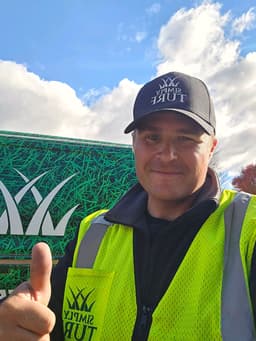
Patrick Klippen
Owner of Simply Turf
Free quote
Get a Quote Today & We'll Send Our Free Lawn Care Guide
- 100% satisfaction guarantee — we don't rest until you're happy
- Rated 4.8 out of 5 from 126+ local reviews
- Local to Gainesville, VA — serving Loudoun, Fairfax, Prince William & Fauquier Counties
We typically respond in 30 minutes or less
Prefer to talk? Call or text (703) 268-9900